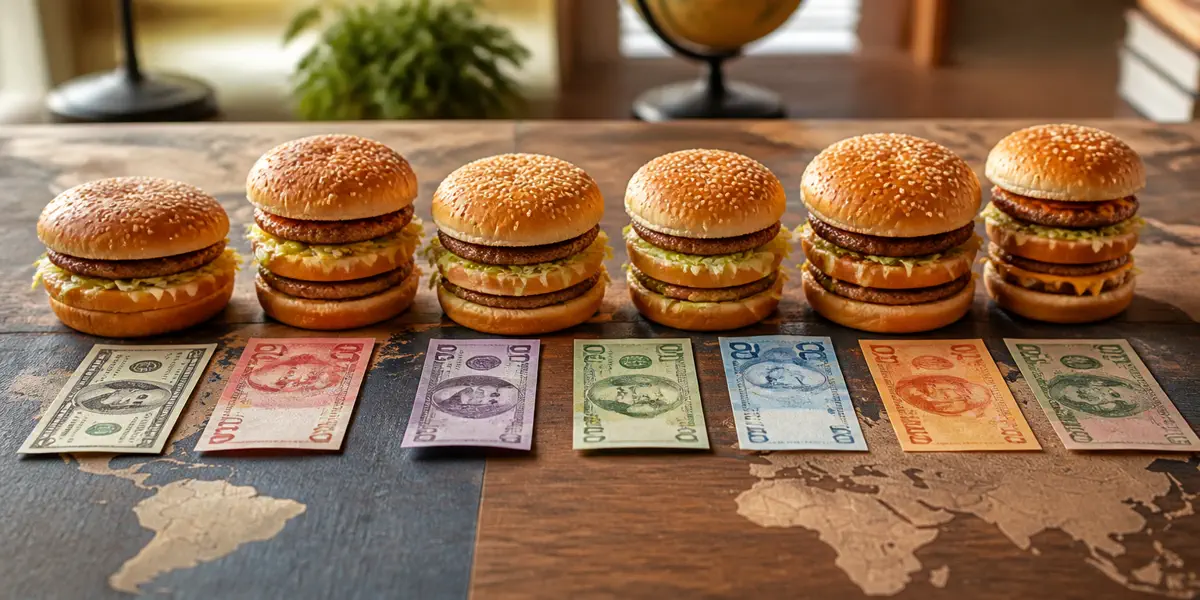
Switzerland: the world's most expensive Big Mac (~$7–$8) — a structurally strong franc.
Japan: relatively cheap for years, and recent yen weakness only widened the gap.
United States: the reference, $5–$6.
Egypt and India: far cheaper in local currency than in the U.S. — though still a meaningful chunk of local incomes.
Where it breaks down
Before you get ahead of yourself: this is an intuition tool, not a precision FX model. Four holes in it.
- Labor costs differ. Lower-income countries make a Big Mac more cheaply, so of course it prints cheaper.
- Rent and tax structures. Where retail real estate is brutal (Switzerland, Hong Kong), the burger price climbs right along with it.
- Cultural demand. In markets that treat burgers as premium dining, prices run higher.
- Input prices. Beef and wheat costs feed straight through.
That's why The Economist also publishes a GDP-adjusted Big Mac Index. Fold in income levels and the signal turns a lot more realistic.
Using it properly
- Don't call it from a single snapshot or one line — start with the multi-year movement.
- Read it alongside nominal FX, CPI, and cost-of-living indices.
- For actual travel or spending decisions? Local wage versus price beats the index, hands down.
On the quiz
PriceGuess's Big Mac Quiz pits two countries' USD-converted Big Mac prices against each other. Play a few rounds and a structural sense kicks in — "this place is usually pricey," "that one's cheap." That grows into PPP intuition. And from there, exchange-rate news starts reading differently.
Working the index out by hand
It stays fuzzy in words, but compute it once yourself and it snaps into focus. Using round figures as of writing, take it slow: say a Big Mac costs about $5.7 in the U.S. and about ₩5,500 in Korea. Divide one by the other and out pops the exchange rate the burger implies.
- Step 1: 5,500 won ÷ 5.7 dollars = about 965. So the Big Mac implies 1 USD = about 965 KRW.
- Step 2: Say the actual market rate is 1 USD = about 1,350 KRW.
- Step 3: 965 ÷ 1,350 = about 0.71. Subtract from 1 and you get about 0.29 — the won looks roughly 29% undervalued on the burger basis.
The weight lands on "looks." That 29% from a single burger isn't a precise fair value; it's a rough signal that translates a hamburger price gap into the language of exchange rates. Run the same arithmetic on the yen, yuan, or euro and you build a sense of which currencies appear relatively cheap.
Common misconceptions and a short FAQ
Myth 1: a low Big Mac reading means that currency is bound to rise. Nope. "Undervalued" only flags a gap between theory and market; the index says nothing about when or how that gap closes. Trade structure, interest rates, and policy pull far harder.
Myth 2: a cheap Big Mac means everything in that country is cheap. Not at all. A Big Mac is one product that mashes beef, retail rent, labor, and marketing into a single lump. Housing, healthcare, and schooling can run the opposite direction entirely.
- Q. So why bother with it? Because it turns the abstract blob of FX and prices into something you can hold — one hamburger.
- Q. Is there anything more accurate? Official PPP statistics, built on a broad basket of goods, are more precise. The Big Mac Index is the friendly miniature of that idea.
- Q. Does it help when traveling? Good for the big picture. But what you actually feel tracks local wage versus price more closely.