Flip the mirror. Travel gets cheaper, imports get cheaper, consumers are thrilled. But the exporters who earn dollars watch each dollar shrink into fewer won — and they sigh. Same event, opposite reactions.
Korea's most cinematic exchange-rate moments
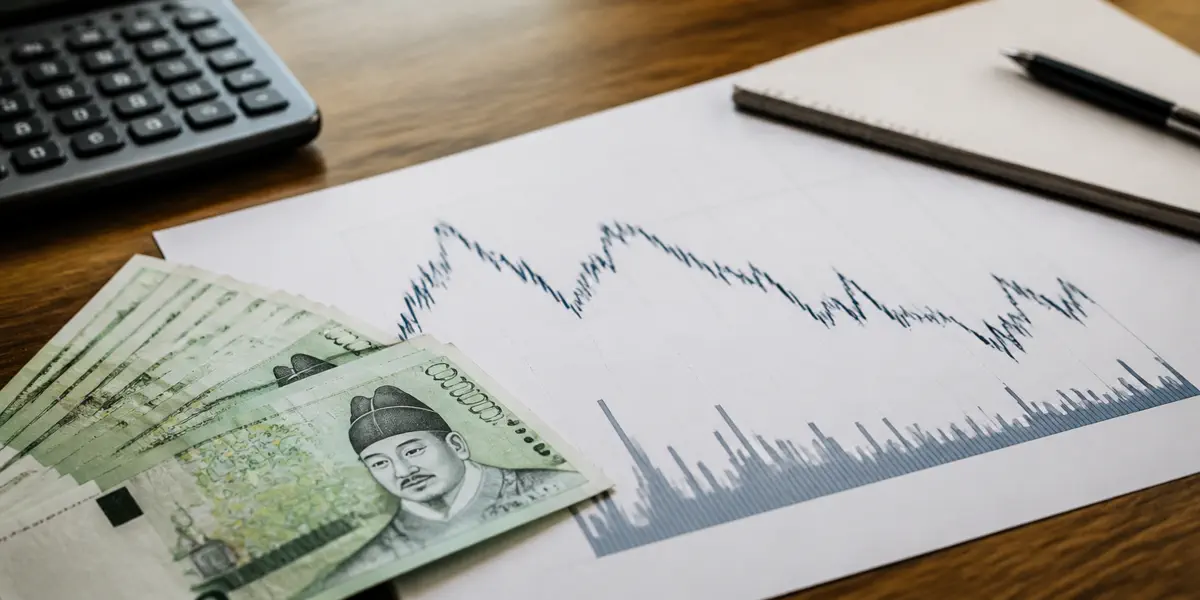
1997, the IMF crisis. The rate shot from the 800s to 2,000 won almost overnight. Import prices more than doubled. Companies sitting on foreign debt toppled one after another.
2008, the financial crisis. It leapt from the 900s to 1,500 won. Korean students abroad felt their tuition effectively spike 60%-plus — straight out of their bank accounts.
2020, COVID. A brief run to 1,280, then calm. Later, as the U.S. hiked rates through 2022–2023, it settled into the 1,300–1,400 range.
The exchange rate is already wired into your daily life
It hides in more places than you'd guess.
• Netflix subscription — Priced in USD. When the rate rises, Korean plans can follow.
• Online shopping from abroad — You feel it the moment you check out on Amazon or iHerb.
• Study-abroad costs — Tuition and living expenses are both leashed to the rate.
• Fuel prices — Crude oil trades in dollars. A weaker won means a bigger number at the pump.
Three forces that push the rate around
1. The interest-rate gap. When U.S. rates sit above Korea's, money drifts toward the better payout. It piles into dollars, the dollar strengthens, and the rate rises.
2. The trade balance. Heavy exports pull dollars into the country and the won strengthens; heavy imports send dollars out and the won weakens.
3. Geopolitical risk. When tension flares on the Korean peninsula, or the world gets jittery, people run to the dollar as a safe haven. That's why the rate twitches in every crisis.
Want to test your global price instincts? Take a crack at guessing Big Mac prices by country.
Let's trace it with one box of ramen
When the rate feels abstract, shrink it. Say a shop imports a box of ramen from abroad for 100 dollars. At 1,200 won, the import cost is 120,000 won. Bring the same box in at 1,350 won and it's 135,000 won. The product and the supplier didn't budge, yet the cost climbed 15,000 won — about 12.5% — purely because of the rate.
The shop either swallows that gap or quietly tacks it onto the shelf price. So the answer to "the ingredients cost the same, why does the price keep climbing?" is often hiding right here. Flip it: if the rate drops to 1,100 won, that same box is 110,000 won. The bigger an item's import share, the more its price relaxes when the won strengthens.
- Rate 1,100 won → a 100 dollar box = 110,000 won
- Rate 1,200 won → a 100 dollar box = 120,000 won
- Rate 1,350 won → a 100 dollar box = 135,000 won
Three myths everyone falls for at least once
Myth 1. "A rising rate is always bad." A burden for consumers and travelers, sure. But exporters who earn in dollars, and people receiving remittances from abroad, are happy — the same dollars turn into more won. Good or bad depends entirely on which side of the trade you're standing on.
Myth 2. "The government sets the rate." Nope. Day-to-day rates are hammered out by countless trades in the market. Central banks sometimes step in to soften a sharp swing, but it's not a number anyone nails down like a price tag.
Myth 3. "If it's at a record high, it must fall soon." Personally, this is the scariest illusion of the bunch. The rate moves on a tangle of interest rates, trade, and sentiment, so past records alone can't call the next move. 1997 and 2008 had their elevated stretches on the record — but the record guarantees nothing about what's next.